Most businesses calling a B2B SEO agency for the first time expect one clear number and instead receive three proposals, five disclaimers, and a spreadsheet. The real cost depends not on what you want but on what the agency discovers when they look under your site's bonnet: technical work, market competition, content volume, and whether your business sells one product line or seventeen. B2B SEO agency costs in Australia vary widely depending on scope, with initial strategy and technical setup adding a significant upfront investment.
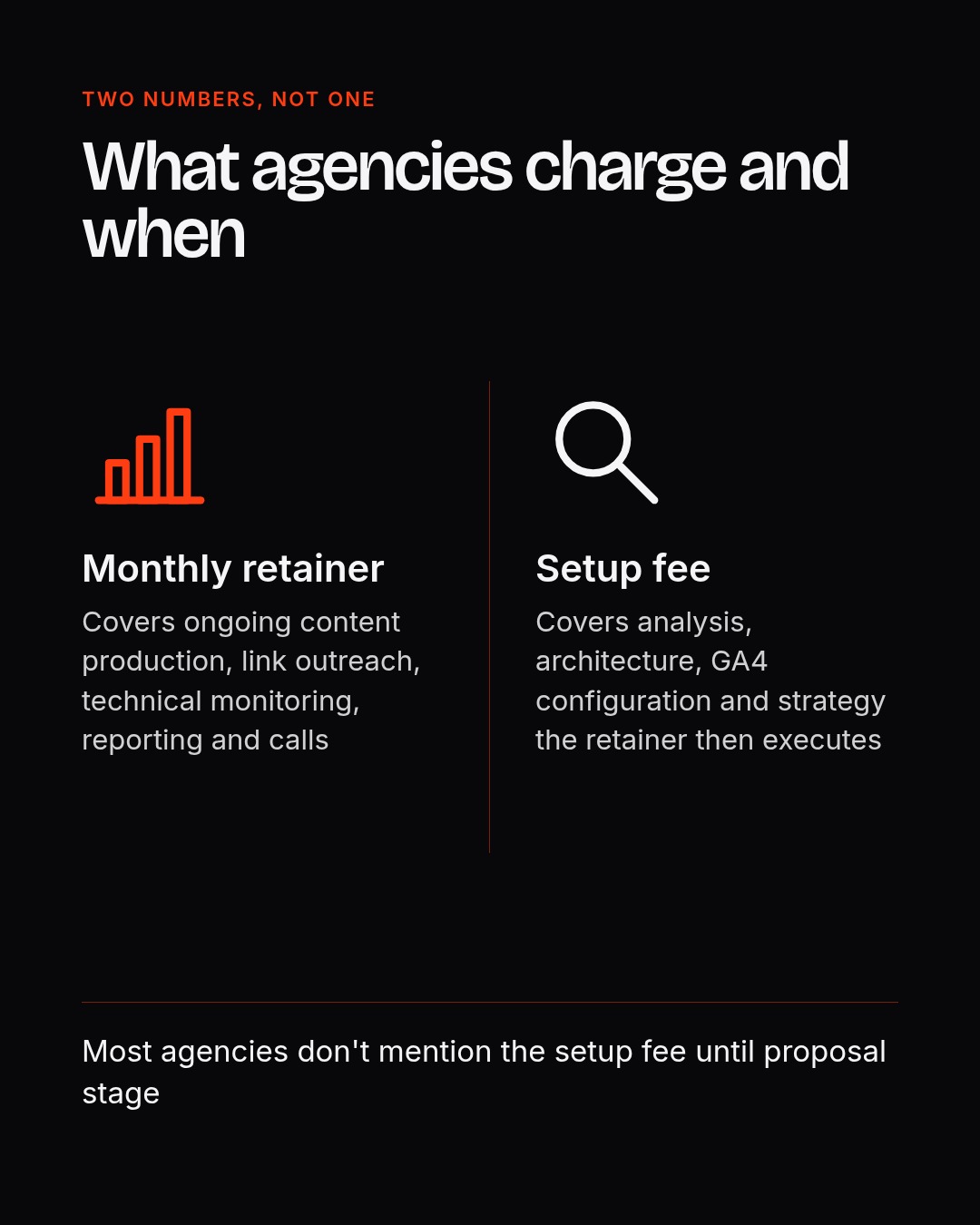
That starting fee alone causes half the sticker shock. The monthly retainer covers the ongoing work: content, link acquisition, reporting, technical monitoring. The setup fee covers the analysis, architecture, GA4 configuration, and strategy the retainer then executes. Both are necessary, and most agencies don't mention the second number until proposal stage.
Key Takeaways
- Retainer costs vary with scope and market competition
- Upfront strategy and technical work adds a significant fee before the retainer begins
- Prices may exclude GST in published quotes; confirm whether yours is quoted inclusive or exclusive
- Contract scope determines the cost more than keyword volume: content production, link building, and technical fixes drive the largest variation
- Monthly fees cover execution; setup fees cover analysis, architecture, and GA4 configuration the retainer depends on
What the Monthly Retainer Actually Pays For
The monthly fee covers recurring work the agency can predict and schedule. Most retainers include ongoing content production, technical SEO monitoring, link outreach, reporting, and regular calls. What changes the number is volume: how many articles per month, how many target keywords, how many service pages need optimisation, and how many backlinks the campaign needs to compete.
Smaller retainers generally fund a modest volume of articles monthly, basic technical monitoring, light link building, and monthly reporting. Mid-tier retainers usually deliver more frequent content, regular technical fixes, active digital PR, detailed GA4 analysis, and more regular check-ins. Enterprise programs typically include custom content plans, multiple target markets, priority technical support, and integrated CRM and marketing automation tracking.
The retainer does not cover the upfront work. Strategy, technical audits, keyword research, competitor analysis, analytics setup, site architecture changes, and migration planning sit outside the monthly fee. Most agencies charge that separately as a project before the retainer starts.
Some agencies absorb it into the first months of the contract; others itemise it as a one-off. Ask which model the proposal follows, because a low monthly retainer paired with a high setup fee can cost more over time than a higher retainer with no project charge.

Where the Setup Fee Goes
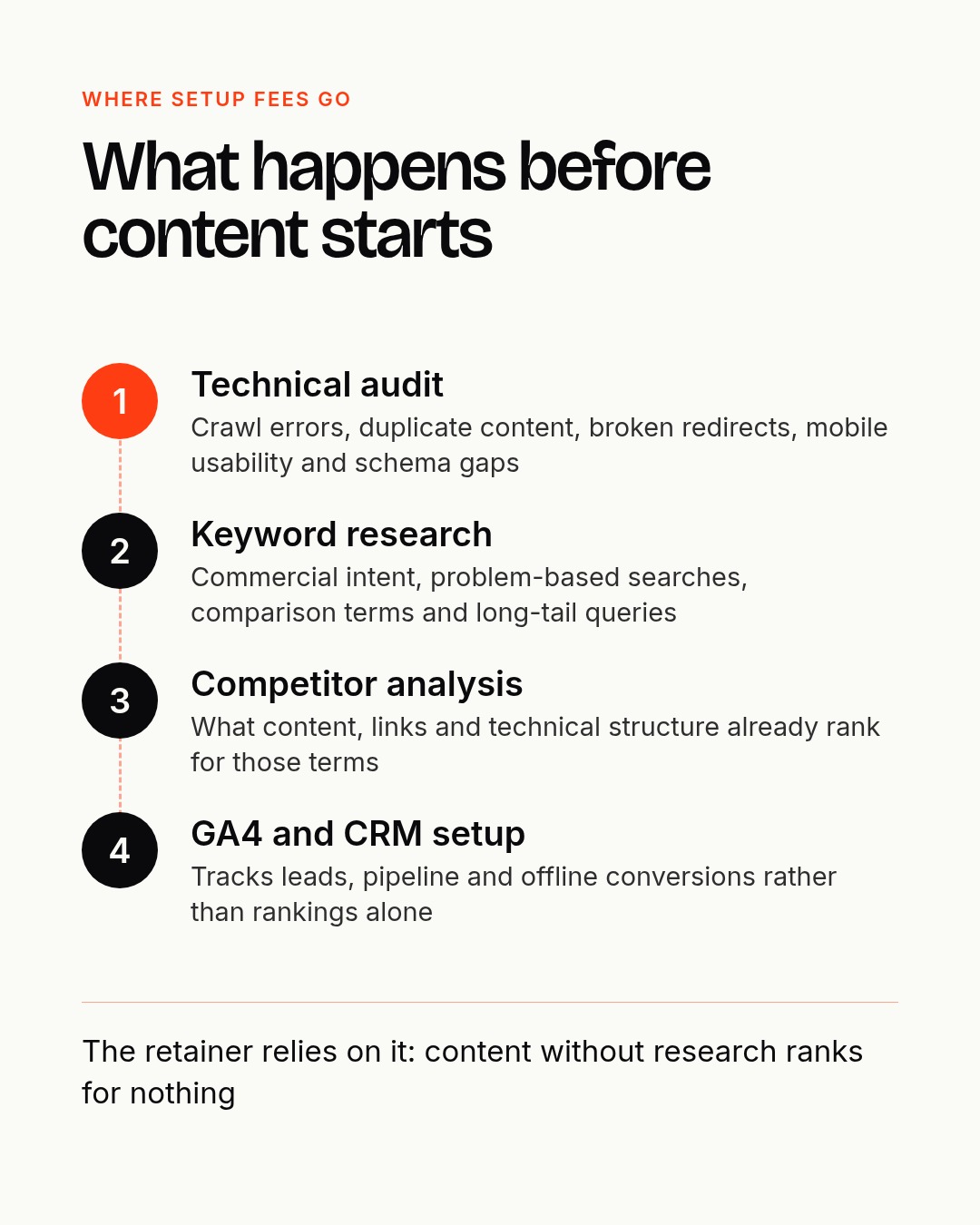
The setup fee funds the analysis and planning before any content or links are built. A technical audit identifies crawl errors, duplicate content, broken redirects, slow load times, mobile usability issues, and schema markup gaps. Keyword research maps commercial intent, problem-based searches, comparison terms, and long-tail queries specific to the business's service lines.
Competitor analysis shows what content, links, and technical structure already rank for those terms. Site architecture planning determines navigation, internal linking, and URL structure. GA4 and CRM configuration tracks leads, pipeline, and offline conversions rather than rankings alone.
This work takes time depending on site size and complexity. Smaller professional-services sites need less analysis; larger SaaS platforms with multiple product lines take longer. The setup fee reflects hours, not difficulty. Agencies charge it because the retainer relies on it: content published without keyword research ranks for nothing, and links built to pages with crawl errors are wasted.
Some agencies bill it as a separate project and refund part of it if the business commits to a longer retainer. Others fold it into the first invoices. A third model charges the retainer from day one and completes setup in parallel, meaning the business pays full price before strategy is finished. Ask how the agency structures it, when setup concludes, and whether any of the fee is credited back against the retainer. The answer changes the real cost and the timeline to first results.
What Moves the Price Up or Down
Website size is the first variable, with larger sites requiring more audit and optimisation hours than smaller ones. Market competition, content production volume, and link building scope drive the largest cost variations within the monthly retainer.
Website size is the first variable. A twenty-page consultancy site needs fewer hours than a three-hundred-page ecommerce catalogue. The agency audits every indexed page, optimises site structure, and monitors technical health. More pages means more work, and the retainer adjusts accordingly. Number of service lines follows the same logic: a business selling one product line targets a narrow set of keywords; a business with ten service categories needs content, links, and technical work across all of them.
Market competition drives the next shift. Ranking for commercial terms in crowded industries requires more content, higher-authority backlinks, and longer campaigns than ranking for niche professional services. An agency competing in Melbourne legal services or Sydney property development needs larger budgets than one working in regional manufacturing or specialist B2B software. The work itself doesn't change; the volume and authority threshold do.
Content production is the largest line item inside most retainers. Writing, editing, publishing, and illustrating articles takes hours, and agencies charge per article or per word. A campaign publishing two articles monthly costs less than one publishing eight. Some businesses need only blog content; others want optimised service pages, case studies, white papers, and landing pages. The more content types in scope, the higher the retainer. Agencies that handle content in-house generally charge more than those outsourcing it, but delivery is faster and revisions are simpler.
Link building adds the second major cost block. Acquiring high-authority backlinks from Australian business directories, industry publications, and relevant editorial sites requires outreach, relationship building, and often content creation for the linking site.
Some agencies include a set number of links per month in the retainer; others charge per link or run digital PR campaigns billed separately. Ask what link acquisition is included, what benchmarks the agency targets, and whether additional link building incurs extra fees. A retainer with no link work attached will rank poorly in competitive markets, regardless of content volume.
GST and Contract Structure
Many published Australian agency prices exclude GST, meaning the final invoice is higher once the ten per cent tax is added. Contract length affects pricing too, with longer commitments generally costing less per month than rolling agreements.
Many published Australian agency prices exclude GST. Confirm whether the proposal quotes figures inclusive or exclusive of GST before comparing agencies. Some agencies absorb GST into their published pricing; others add it at invoice stage. The difference can be significant over a year and can change which proposal offers better value.
Contract length affects pricing too. Month-to-month agreements generally cost more per month than longer commitments. Agencies discount longer contracts because they can plan resource allocation and hire accordingly. The trade-off is flexibility: a locked contract penalises early exit, while a monthly agreement lets the business pause or cancel without penalty. Balance the discount against the risk of being locked into an underperforming campaign.
Some agencies bundle additional services into the retainer and others itemise them separately. Paid search management, social media advertising, email marketing, and conversion-rate optimisation often sit outside the SEO retainer even when the same agency delivers them. Ask what the proposal includes and what incurs separate fees. An apparently cheaper retainer that excludes GA4 setup, CRM integration, and quarterly strategy reviews can end up costing more once those are added back in.
Timeline and When Results Appear
Results build gradually with regular work. B2B sales cycles extend that further, meaning sales sourced from organic search may not close for an extended period.
SEO is a lag-heavy channel. Results build gradually with regular work, and lead generation follows. B2B sales cycles extend that further: a business selling enterprise software or professional services might not close a sale sourced from organic search for an extended period after the initial contact. The retainer funds ongoing work during that lag, which is why agencies resist project pricing and push monthly commitments.
The early months typically deliver technical fixes, initial content, and early link acquisition. Rankings move slightly, traffic lifts marginally, and lead volume stays flat. Later months show clearer ranking gains, traffic growth, and qualified enquiries. Ongoing campaigns produce compounding results as more content ranks, more links accumulate, and domain authority rises. Businesses that cancel early generally waste the investment; those that run campaigns for an extended period see ROI.
Agencies that promise fast results are either targeting low-competition keywords or overstating what SEO can deliver. Ranking for competitive commercial terms in Australian B2B markets takes sustained effort, and the timeline depends on the starting point. A site with strong technical health and existing backlinks climbs faster than one with crawl errors, thin content, and no inbound links. Ask the agency what timeline they base their proposal on and what assumptions they made about current site performance. An honest answer includes caveats; a vague one hides risk.
AI Search and Answer-Engine Optimisation
Traditional SEO targets Google's organic results. Answer-engine optimisation targets ChatGPT, Perplexity, Gemini, and Google's AI Mode, which launched in Australia in October 2025.
AI adoption in Australia is increasing rapidly, and a growing proportion of Australians now use AI as their primary way to find information online.
Answer engines cite sources rather than rank them. A well-optimised article appears as a quoted reference in an AI-generated answer, with attribution and a link. That changes how content must be written: shorter, more direct answers to specific questions, structured data markup for key facts, and clear entity associations so the AI understands what the business does and where it operates. Agencies offering AI SEO services in Australia typically charge the same retainer as traditional SEO but shift content strategy toward answer-focused formats.
Tracking AI citations requires different tools. Google Search Console and GA4 show organic search performance but not how often a business is named in ChatGPT or Perplexity responses. Some agencies now include citation tracking in their reporting, measuring how often the business appears as a source in AI answers and which queries trigger those citations.
Ask whether the agency tracks AI visibility and whether that reporting is included in the retainer or billed separately. Businesses targeting younger buyers or technical audiences should prioritise agencies that understand answer-engine dynamics, as those cohorts increasingly bypass Google entirely.
When Hourly Consulting Makes More Sense
Not every business needs a retainer. Hourly consulting suits businesses with internal marketing teams who need strategic direction, technical audits, or training rather than execution. Australian SEO agencies and SEO companies offer consulting work with no minimum commitment. A business might pay for a technical audit, implement the recommended fixes in-house, then return for a follow-up review later.
Hourly work costs less upfront but delivers no ongoing execution. The business receives a roadmap, a list of technical issues, and keyword recommendations, then builds the content, acquires the links, and monitors performance itself. That works when the business has a content writer, a developer, and a marketer who understand SEO. It fails when the business lacks the internal resource or discipline to execute consistently. Retainers cost more but guarantee the work gets done; hourly consulting saves money but transfers execution risk to the business.
Some agencies offer hybrid models: an initial consulting engagement to build strategy, followed by a smaller retainer covering only content production or link building while the business handles technical work internally. Ask whether the agency supports that structure and how they price it. A consulting phase followed by a part-retainer often delivers better value than a full-service retainer for businesses with capable internal teams.
How Ranki Handles SEO Without the Retainer Model
Ranki operates on monthly plans with no lock-in contract, publishing researched and illustrated articles automatically every month to WordPress, Shopify, Wix and coded sites. Keyword rankings are tracked weekly, and phone calls and form enquiries are tracked back to the page that produced them.
Most agencies charge a setup fee, a monthly retainer, and separate fees for technical work, content, and links. Ranki automates the content and publishing side, which removes the largest cost block from traditional retainers. The platform connects to WordPress, Shopify, Wix, and coded sites, chooses keywords from real search data, then researches, writes, illustrates, and publishes articles automatically every month. Keyword rankings are tracked weekly, and phone calls and form enquiries are tracked back to the page that produced them.
Plans are monthly with no lock-in contract. Everything published stays on the site if the business leaves. Ranki is based in Sydney and works with businesses anywhere in Australia and overseas. All work is done online; there are no in-person meetings or site visits. The service targets businesses that want more calls and enquiries from Google and AI search without a large agency retainer or writing content themselves.
For Shopify stores, Ranki writes collection page copy as well as blog articles. The platform also measures how often a business is named in AI answers from ChatGPT, Perplexity, Gemini, and Google AI Overviews. That citation tracking sits outside most traditional SEO retainers but is included in Ranki's standard plans. Current pricing is published at ranki.com.au, and plans change as the service evolves.
Ranki does not replace a full-service SEO agency in Australia for businesses that need custom strategy, technical migrations, enterprise reporting, or integrated digital PR. It replaces the content production and publishing side of a retainer for businesses that handle technical SEO in-house or work with a developer separately. The automation trades flexibility for cost and speed: the content follows a proven structure and keyword strategy, but it cannot be customised to match brand voice or editorial calendars as closely as a human writer working inside the business.
Questions to Ask Before You Sign
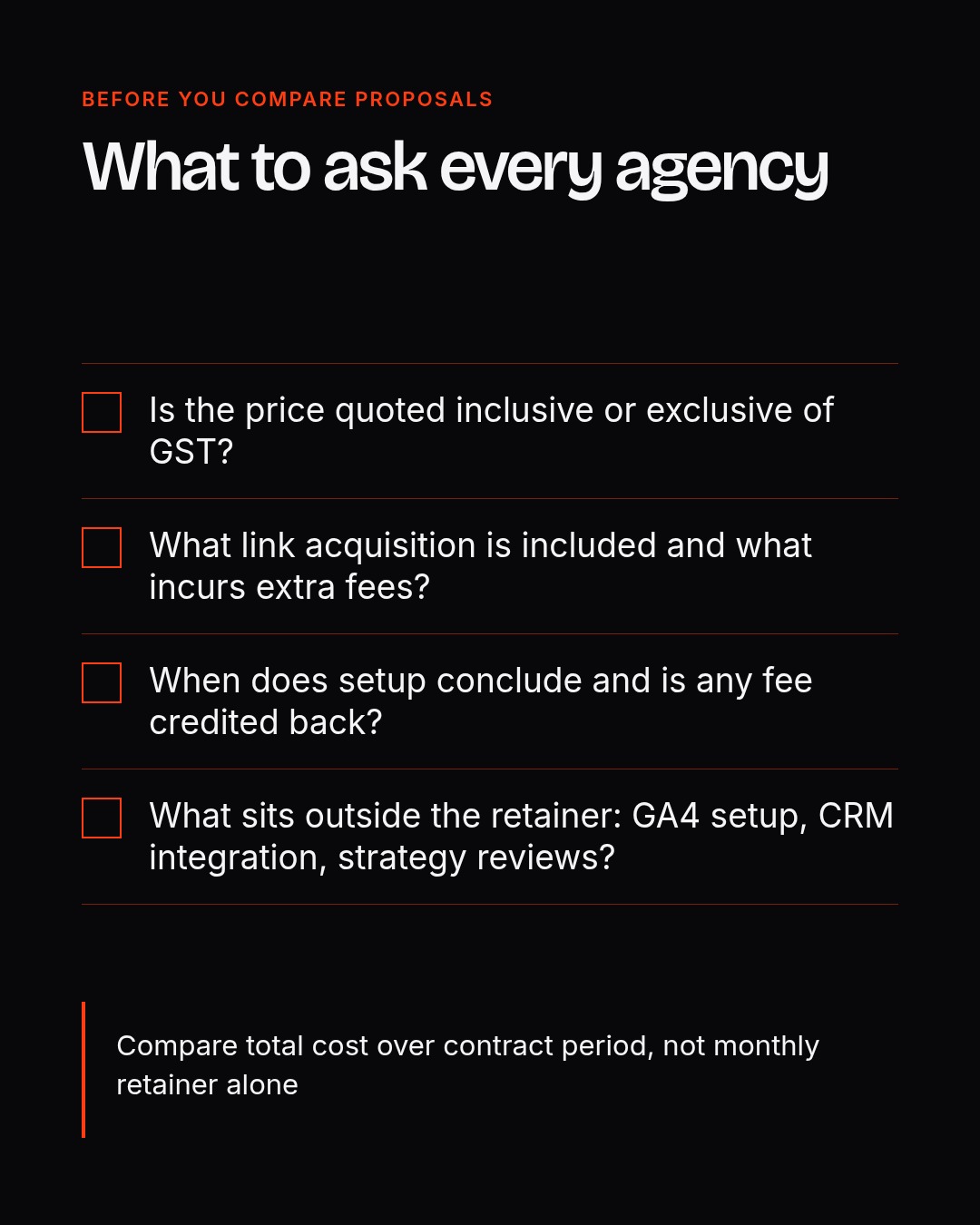
Ask what the setup fee includes and when it is billed. Ask whether it is refunded or credited if the business signs a twelve-month retainer. Ask what the monthly retainer covers: how many articles, how many target keywords, how many backlinks, and whether technical fixes, GA4 setup, and CRM integration are included or billed separately. Ask how the agency tracks leads and whether they measure pipeline and revenue or only rankings and traffic.
Ask what happens if results underperform. Some agencies offer performance guarantees or pause billing if rankings don't improve within six months. Others lock the business into a contract regardless of results. Ask whether the contract is month-to-month or fixed-term, and what the exit terms are. Ask whether the content and links built during the contract remain with the business if they cancel, or whether the agency removes them.
Ask how the agency handles AI search and whether citation tracking is included. Ask to see a sample report and whether it separates organic search traffic from AI referrals. Ask whether the agency writes content in-house or outsources it, and whether revisions and updates are included in the retainer or charged separately. Ask what technology the agency uses: do they publish to the business's CMS directly, or do they deliver content as documents for the business to upload?
Finally, ask whether the pricing is quoted inclusive or exclusive of GST, and whether the proposal lists all fees or whether additional charges apply for technical work, migrations, or strategy reviews. The answers determine whether the proposal represents the real cost or just the opening number in a longer conversation.
Common Questions About B2B SEO Agency Costs
Is SEO worth it for a B2B business in Australia?
SEO generates qualified leads over time without ongoing ad spend, which makes it worthwhile for businesses with long sales cycles and high customer lifetime value. The investment pays back when leads convert, but the timeline is six to twelve months minimum. Businesses expecting immediate results are better served by paid search or direct outreach.
Which Sydney SEO agencies publish their pricing publicly and have no lock-in contract?
Most Sydney agencies keep pricing private and quote based on scope. Ranki is based in Sydney, publishes plans at ranki.com.au, and runs month-to-month with no lock-in contract. The platform handles content production and publishing automatically, which removes the largest cost block from traditional retainers. For custom strategy, technical work, or enterprise reporting, most businesses still need a traditional agency relationship.
How much does answer-engine optimisation cost in Australia?
Answer-engine optimisation typically costs similarly to traditional SEO retainers because the work volume is similar. The difference is content structure and tracking: agencies shift toward question-focused formats and measure how often the business is cited in AI answers from ChatGPT, Perplexity, and Google AI Overviews rather than only tracking rankings.
What is a B2B lead-gen agency and how does it differ from an SEO agency?
A B2B lead-gen agency focuses on generating sales-qualified leads through multiple channels: paid search, LinkedIn advertising, email outreach, webinars, and content syndication. An SEO agency focuses on organic search visibility and builds long-term ranking authority. Lead-gen delivers faster results but costs more per lead and stops when the budget stops. SEO takes longer to build but compounds over time and continues generating leads after the retainer ends.
Which agencies in Australia specialise in optimising for ChatGPT and Perplexity?
Most Australian SEO agencies now include AI search optimisation in their services, but few specialise exclusively in it. Ranki measures how often a business is named in AI answers from ChatGPT, Perplexity, Gemini, and Google AI Overviews as part of its standard tracking. Traditional agencies typically fold AI optimisation into broader SEO retainers rather than offering it as a standalone service, because the content and technical work overlap with organic search strategy.
Deciding Whether to Proceed
Compare proposals at total cost rather than monthly retainer alone, adding setup fees and GST if quoted exclusive. Balance the discount on longer contracts against the risk of being locked into an underperforming campaign without flexibility to pause or cancel.
A B2B SEO retainer is a long-term investment, not a quick fix. The business should have an appropriate budget, the internal capacity to review reports and provide feedback, and realistic expectations about timeline. SEO works best when paired with other channels: paid search for immediate leads, LinkedIn for relationship building, email for nurturing, and content marketing for authority. Treating SEO as the only marketing channel rarely succeeds, but combining it with a broader strategy compounds results.
Compare proposals at total cost over the intended contract period, not monthly retainer alone. Add the setup fee, account for the full contract duration, include GST, and factor in any separate charges for technical work, link building, or reporting. Ask each agency what results they expect over time, what metrics they track, and how they measure success for B2B clients. The agency that promises the fastest results is often the one delivering the least sustainable work.
Finally, confirm what stays with the business if the contract ends. Some agencies remove backlinks, delete published content, or revoke access to analytics dashboards when a client cancels. Others leave everything in place. The content and links built during the retainer represent the business's investment, and keeping them ensures the work compounds even after the agency relationship ends.