AI tools now answer searches constantly, and many of those answers leave Google out entirely. ChatGPT, Perplexity, Gemini and Microsoft Copilot pull information straight from the web, build an answer in seconds, and never send anyone to your site. If your business isn't part of that answer, you're invisible. A geo agency optimises your brand and content so AI engines cite you when someone asks about your industry, location or service.
The work overlaps with traditional SEO but adds citation tracking, structured content, digital PR and entity positioning so your name appears in AI-generated answers, not just search results. For Australian businesses competing in tight local markets, being named by AI can be the difference between a full calendar and an empty one.
Key Takeaways
- GEO aims to get your business cited by ChatGPT, Perplexity, Google AI Overviews and similar tools, not just ranked in search results
- Most Australian programmes run month to month with measurement of AI mentions, not locked contracts
- Work includes technical audits, structured content, digital PR, entity building and competitor tracking
- Ask how the agency tracks AI citations and whether the work ties back to real enquiries, not just impressions
- Avoid any provider that promises guaranteed AI mentions or guarantees a timeline - no one controls what an AI tool cites
What a GEO Agency Actually Does
Generative Engine Optimisation is the practice of making your brand and content more likely to be cited when an AI tool generates an answer. Someone types "which electrician do I call for a switchboard upgrade in Parramatta", and Perplexity or ChatGPT writes a response. If your name appears in that answer, they contact you. If it doesn't, they contact whoever does.
The work splits into several streams. Technical optimisation covers schema markup, entity linking and site structure so AI systems can parse what you do and where you operate. Content strategy means publishing structured, citeable articles that answer the questions people actually ask - often pulled from Google's People Also Ask data or Search Console. Digital PR and link acquisition position your brand on external sites AI tools already trust, so your name appears in their training data and live scrapes. Citation tracking measures how often your business is named across ChatGPT, Perplexity, Google AI Overviews and other platforms, then ties that back to leads.
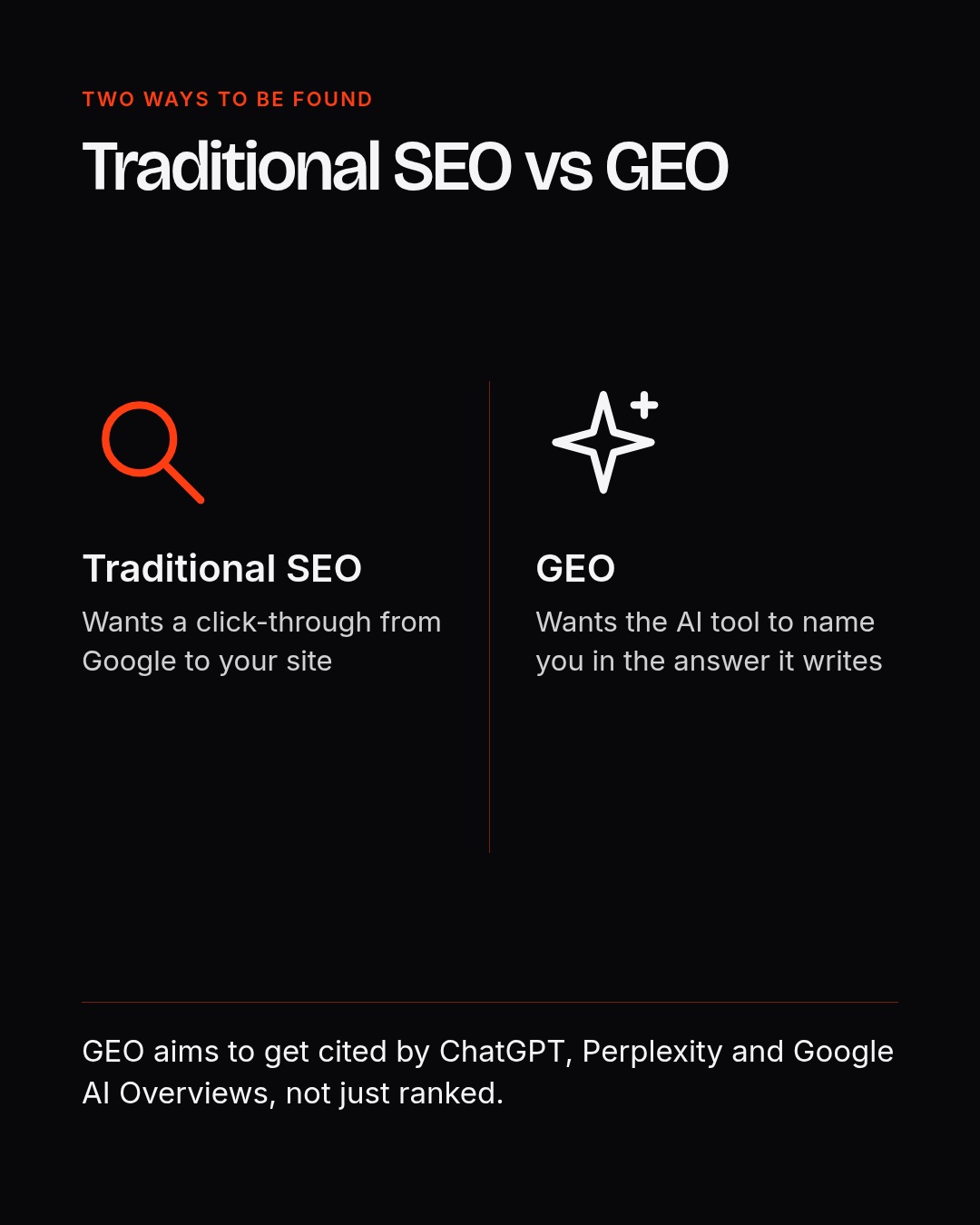
If a provider calls it Answer Engine Optimisation (AEO) or AI search optimisation instead, they mean the same thing. The methods overlap heavily with modern SEO, but the goal is different: traditional SEO wants a click-through from Google; GEO wants the AI tool to name you in the answer it writes, so the reader never visits Google at all.
An SEO agency in Australia that also offers GEO will usually fold the work into one programme, since the technical and content foundations are shared. A pure-play GEO provider focuses only on AI citation and may charge separately for conventional search ranking.
How Long the Work Takes and What Timing to Expect
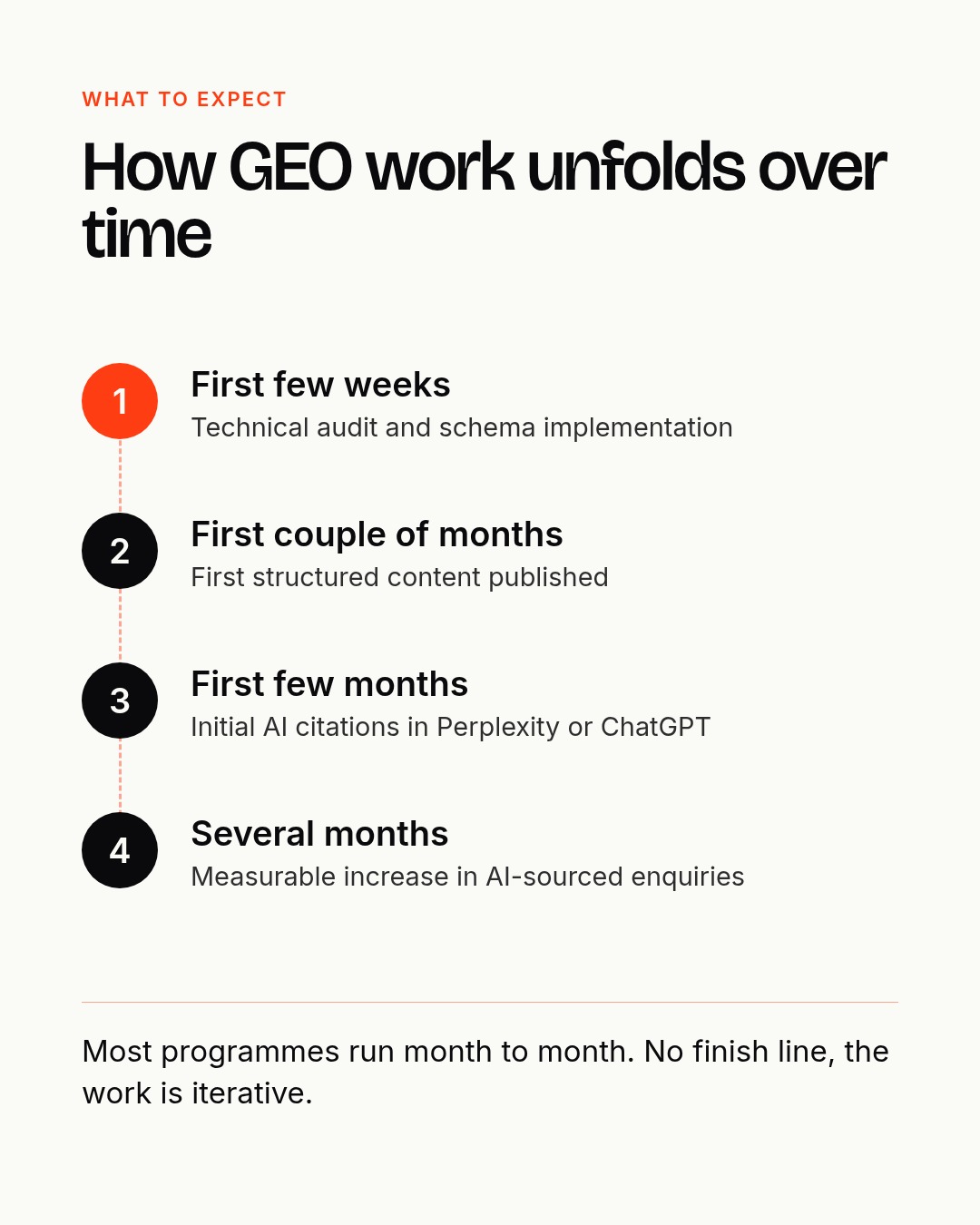
Most programmes run month to month. AI tools update their training data and live-scraping routines constantly, so there's no finish line - the work is iterative. Early results (your first AI mentions in Perplexity or ChatGPT) can appear within weeks if the agency publishes structured content quickly and your brand already has decent domain authority. For newer sites or less-established businesses, meaningful citation volume often takes a few months.
The timing depends on several factors. Domain authority and existing backlinks affect how quickly AI tools trust and cite your site. A well-linked local business with years of history gets cited faster than a startup. Competitor strength matters: if five other providers in your area already dominate AI answers, displacing them takes longer. Content volume plays a role too - one article a month builds slower than five.
Avoid any provider that promises a guaranteed number of citations by a fixed date. No one controls what ChatGPT or Perplexity cites - those models run on algorithms and training data the agency doesn't own. A realistic provider will describe the work, show you examples of citation growth for other clients, and explain the variables. If they guarantee results on a timeline, they're either overselling or planning to game something that will backfire later.
| Work stream | Typical timeline |
|---|---|
| Technical audit and schema implementation | First few weeks |
| First structured content published | First couple of months |
| Initial AI citations in Perplexity or ChatGPT | First few months |
| Measurable increase in AI-sourced enquiries | Several months |
| Sustained citation volume across multiple AI platforms | Ongoing over time |
These timings assume the agency starts work immediately and the client approves content without long delays. Slower internal sign-off or a need to rebuild site structure first will push everything back.
What to Check Before You Commit
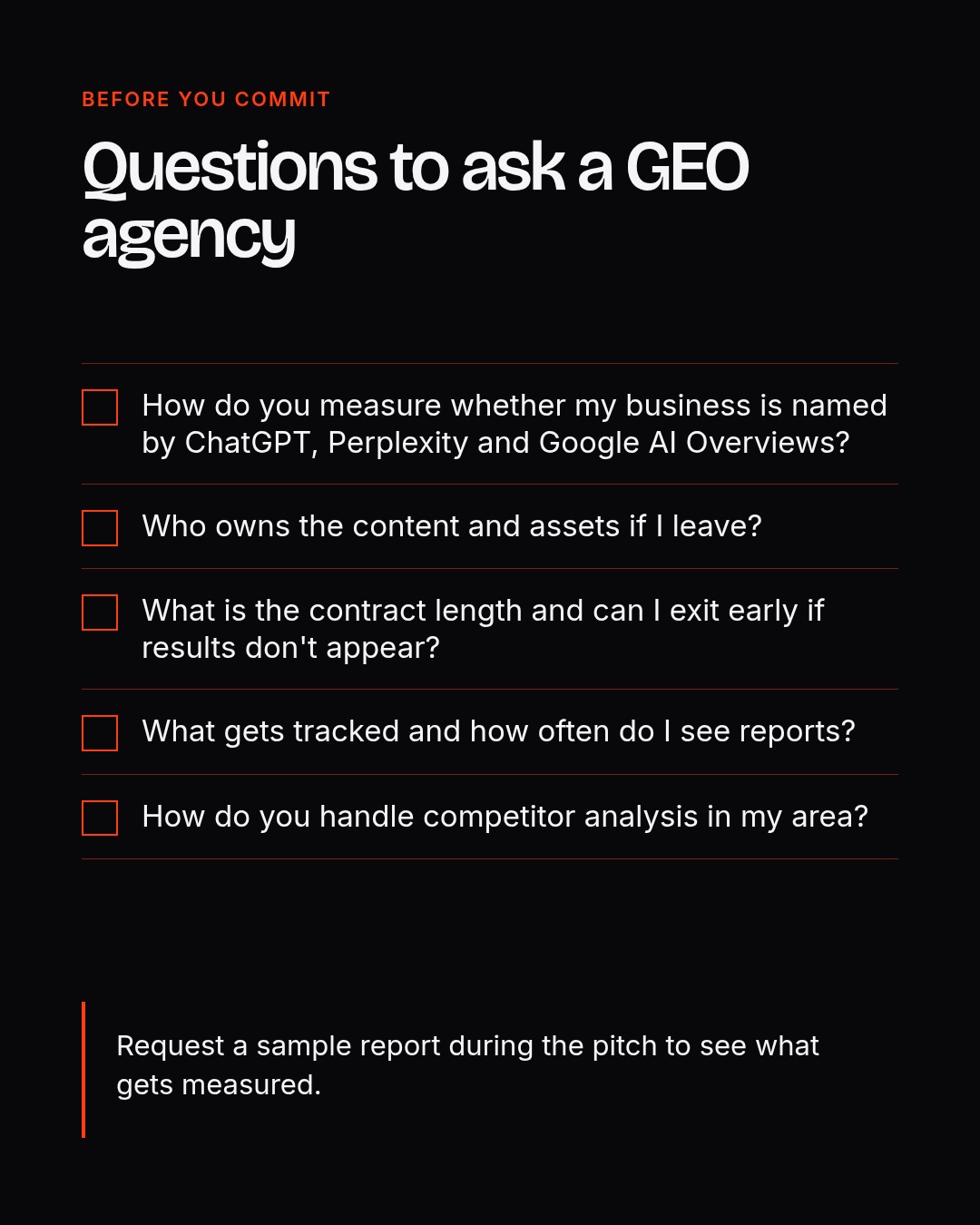
Start with citation tracking capability. Ask how the agency measures whether your business is named by ChatGPT, Perplexity, Google AI Overviews and other tools. Some providers use platforms like BrightEdge or custom scraping scripts; others rely on anecdotal client feedback. If they can't show you a live dashboard or at least a sample report with real citation counts, they're guessing.
Next, clarify who owns the content and assets. If the agency publishes articles, schema markup or backlinks on your behalf, confirm in writing that everything stays with you if you leave. Some contracts transfer content ownership to the provider or delete it when the agreement ends. That wipes out months of work and citation history.
Ask about contract length and exit terms. Most Australian GEO programmes run month to month, but a few lock you in for six or twelve months. If there's a minimum term, ask what happens if results don't appear - can you exit early, or are you liable for the full contract? A provider confident in their work usually offers a short notice period.
Measurement and reporting matter as much as the work itself. Ask what gets tracked (AI mentions, keyword rankings, organic traffic, form fills, phone calls) and how often you see reports. Weekly keyword tracking and monthly citation reports are standard. If the agency only reports once a quarter or refuses to share raw data, you have no way to judge whether the spend is working.
Confirm what platforms the agency optimises for. Some focus only on Google AI Overviews and ignore ChatGPT or Perplexity. Others target the full range. If your customers use a specific tool heavily (for example, tradespeople often use ChatGPT for quick supplier or technique lookups), make sure that platform is covered.
Finally, ask how they handle competitor analysis. If three other businesses in your area already dominate AI answers for your keywords, the agency needs a plan to displace them. That might mean publishing more content, building stronger backlinks, or targeting adjacent keywords where competition is lighter. If they don't mention competitors at all, they're not thinking strategically.
Red Flags That Mean Walk Away
Some warning signs are obvious. If a provider guarantees you'll appear in ChatGPT or Perplexity answers within a fixed timeframe - say, ten citations in sixty days - they either don't understand how AI works or they're planning something questionable. No one controls what these models cite. The best an agency can do is increase the probability through solid technical work, structured content and credible backlinks.
Another flag is vague or generic content. If the sample articles they show you read like chatbot output - no local detail, no specific advice, just reworded definitions - they're not writing for citation. AI tools cite content that shows expertise, specificity and a clear point of view. Generic fluff doesn't get picked up.
Watch out for providers who won't name their tools or methods. If they describe the work as proprietary and refuse to explain even broadly how they track citations or build entity authority, you have no way to verify results or replicate the work later. Legitimate agencies explain their approach clearly, even if they don't hand over every script.
Upfront lump-sum contracts are another concern. A few providers charge the full programme cost in advance, then deliver the work over an extended period. If the results don't appear or the agency underperforms, you've already paid and have little leverage. Monthly billing with the option to cancel keeps both sides honest.
Finally, avoid any agency that claims to have direct partnerships or inside access to OpenAI, Google or Perplexity's ranking systems. They don't. These companies don't sell preferential treatment or citation guarantees. If a provider implies otherwise, they're either mistaken or lying.
What Ranki Measures and Why It Matters
Ranki tracks keyword rankings weekly and measures how often a business is named in AI answers across ChatGPT, Perplexity, Gemini and Google AI Overviews. Phone calls and form enquiries are tracked back to the page that produced them.
AI search changes faster than conventional SEO did in its first decade, and businesses investing in it need to know whether the work is producing leads, not just impressions. Ranki connects directly to WordPress, Shopify and Wix sites and publishes researched, structured articles automatically every month, chosen from real search data. Keyword rankings are tracked weekly, and phone calls and form enquiries are linked back to the page that generated them.
The platform measures how often a business is named in AI-generated answers across ChatGPT, Perplexity, Gemini and Google AI Overviews. That citation data sits alongside conventional keyword tracking, so you see both how visible you are in traditional search results and whether AI tools are recommending you. For Shopify stores, Ranki writes collection page copy as well as blog articles, covering both product discovery and informational content.
Everything runs month to month with no lock-in contract, and all published content stays on your website if you leave. Ranki is based in Sydney and works with businesses across Australia and internationally, with all work handled online. If you want to see how AI citation tracking and automated content publishing work together, visit ranki.com.au to explore current plans.
Frequently Asked Questions
What is GEO in SEO?
Generative Engine Optimisation (GEO) is the practice of positioning your business and content so AI tools like ChatGPT, Perplexity and Google AI Overviews cite you when they generate answers. It overlaps with traditional SEO but focuses on structured content, schema markup, entity building and citation tracking rather than click-through from search results. The goal is to be named in the AI-written answer, not just ranked on a results page.
How much does answer engine optimisation cost in Australia?
The figure depends on scope, competition and the provider's model. It is worth discussing your specific situation with an agency directly to understand what drives the investment. Some programmes focus on audits and monitoring, others include full content production, digital PR and technical implementation. Monthly plans are common, and most run without lock-in contracts.
Which agencies in Australia specialise in optimising for ChatGPT and Perplexity?
Several Australian providers now offer AI search optimisation as a core service. Each has a slightly different approach - some focus heavily on technical schema and entity work, others emphasise digital PR and content volume. Ask each provider to show you sample citation reports and explain how they track mentions across AI platforms before you commit.
How do I prepare my SEO for AI search in Australia?
Start with structured content that directly answers common questions in your industry, written in clear, citeable language. Implement schema markup so AI tools can parse what you do and where you operate. Build your entity profile through consistent NAP (name, address, phone) across directories, and earn backlinks from credible local sites.
Track whether your name appears in ChatGPT, Perplexity and Google AI Overviews for your target keywords, then adjust content and technical setup based on what gets cited. If you lack in-house capacity, an agency that handles research, writing and tracking together can move faster than hiring separately for each task.
Who can help my Sydney business get mentioned by ChatGPT and Perplexity?
Agencies offering GEO, AEO or AI search optimisation handle the technical, content and PR work needed to increase AI citations. Ranki, which is based in Sydney, connects to your existing site and publishes researched content automatically. Request a baseline citation report from any provider before you start, so you can measure progress month by month. If the agency can't show you how they track mentions across AI platforms, choose one that can.
Bottom line: AI tools now answer searches constantly, and your business either appears in those answers or it doesn't. GEO is how you get cited when someone asks ChatGPT, Perplexity or Google AI Overviews for a recommendation in your industry.
The work takes a few months to show results, but the businesses that start now are the ones that dominate AI search later. If you want your name in the answer instead of your competitor's, the checklist above tells you exactly what to look for and what to avoid.